Posts

Labyrinths

“And yet, and yet… Denying temporal succession, denying the self, denying the astronomical universe, are apparent desperations and secret consolations. Our destiny … is not frightful by being unreal; it is frightful because it is irreversible and iron-clad. Time is the substance I am made of. Time is a river which sweeps me along, but I am the river; it is a tiger which destroys me, but I am the tiger; it is a fire which consumes me, but I am the fire. The world, unfortunately, is real; I, unfortunately, am Borges.” ― Jorge Luis Borges, Labyrinths: Selected Stories and Other Writings
Existentialism Is a Humanism | Jean-Paul Sartre (1946)

Image
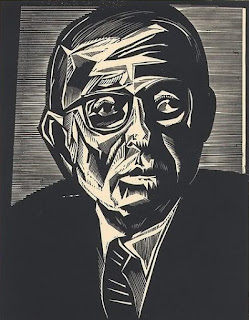
We are left alone, without excuse. That is what I mean when I say that man is condemned to be free. Condemned, because he did not create himself, yet is nevertheless at liberty, and from the moment that he is thrown into this world he is responsible for everything he does. The existentialist does not believe in the power of passion. He will never regard a grand passion as a destructive torrent upon which a man is swept into certain actions as by fate, and which, therefore, is an excuse for them. He thinks that man is responsible for his passion. Neither will an existentialist think that a man can find help through some sign being vouchsafed upon earth for his orientation: for he thinks that the man himself interprets the sign as he chooses. He thinks that every man, without any support or help whatever, is condemned at every instant to invent man. As Ponge has written in a very fine article, “Man is the future of man.” That is exactly true. -  Existentialism is a humanism, J...

A Japanese Contribution to Marxian Political Economy

Image
In this appraisal of historical materialism the peculiarity of Uno's position vis- a-vis other trends of Marxist thought is most clearly seen. The conventional and official view would argue roughly as follows: Marxism has extracted what is to be called dialectical materialism from Hegel's system by "inverting it"; then, the application of this dialectical materialism to social history has created the science of historical materialism; the political economy of capitalism consists of further specification of the principles of historical materialism for the analysis of capitalist society; hence, the discovery of the class-nature of capitalism has made Marxist socialism a science. The conventional view thus fails to distinguish between ideology and science; it even tends to glorify the confusion with the slogan of "the dialectical unity of theory and practice." The more recent and presumably "unofficial" view, inspired by the works of Luk'acs, K...

The Philosopher Who Would Not Be King

Image
At the entrance to the university there was an inscription dedicating the campus to the memory of Leland Stanford, Jr., “born to mortality . . . passed to immortality,” a mother’s undying love metamorphosed into an institution of timber beam, plaster walls, reinforced concrete, and carved stone. So we convert our tragedies into objects that will withstand corrosive rain, seismic upheavals, and time. We place memorial urns in the cloisters, a chapel at the heart of it all, columns and commemorative plaques that lift our eyes from the ground. Even our intellectual labor aspires to the condition of permanence and transcendence, though our lives are transitory in comparison, our miseries commonplace, our labors unavailing. I felt a strong desire to testify to the struggle of those who lacked the means to pretend that life was otherwise. In about an hour I would present a paper about the life of a Kuranko woman for whom this place might well appear to be paradise, but ...

End of politics

Image
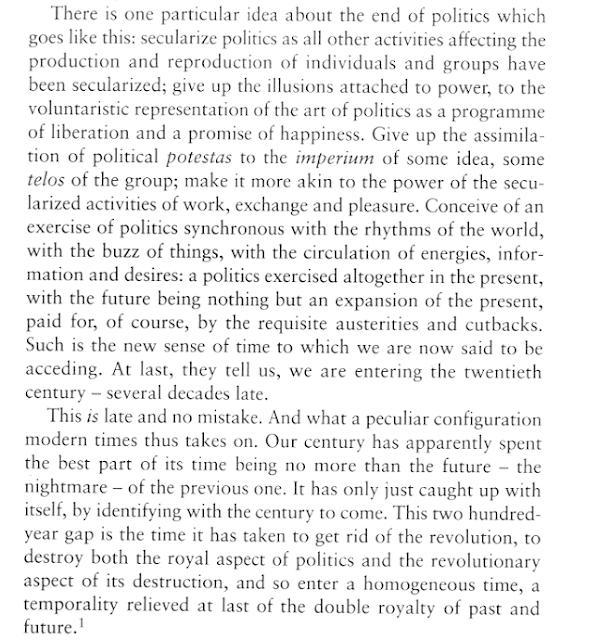
- On the Shores of  ‪#‎ Politics‬ , Jacques  ‪#‎ Rancière‬  - page 6

A ruthless critique against everything existing

Image
The reform of consciousness consists only in making the world aware of its own consciousness, in awakening it out of its dream about itself, in explainin g to it the meaning of its own actions. Our whole object can only be – as is also the case in Feuerbach’s criticism of religion – to give religious and philosophical questions the form corresponding to man who has become conscious of himself. Hence, our motto must be: reform of consciousness not through dogmas, but by analyzing the mystical consciousness that is unintelligible to itself, whether it manifests itself in a religious or a political form. It will then become evident that the world has long dreamed of possessing something of which it has only to be conscious in order to possess it in reality. It will become evident that it is not a question of drawing a great mental dividing line between past and future, but of realizing the thoughts of the past. Lastly, it will become evident that mankind is not beginning a new wor...

The poor fetish: commodifying working class culture

Image
Fruit stall in Shoreditch, London  (Source:  Flickr/Garry Knight ) This inaction hurts the middle-class man. He feels impotent in the blue glare of his computer screen. Unable to do anything useful, alienated from physical labor and plagued by the knowledge that his father could use his hands, and the lower classes still do. Escape, however, is impossible. Ever since the advent of the smartphone the traditional working day has been abolished. Office workers are at the constant mercy of email, a culture of overwork and a digitalization of work. Your job can be done anytime, anywhere and this is exactly what capital demands. Refuge can only be found in sleep, another domain which capital is  determined to control . And when the middle classes are awake and working, they cannot even show contempt for their jobs. Affective (or emotional) labor has always been a part of nursing and prostitution, be it fluffing pillows or faking orgasms, but now it has infected both the ...

Sparrow

Image
» A sparrow limps past on its little bone crutch saying I am Federico Garcia Lorca risen from the dead– literature will lose, sunlight will win, don’t worry.  - From Publication date, Franz Wright

Angelus Novus

Image
Angelus Novus, Paul Klee, 1920 My wing is ready to fly I would rather turn back For had I stayed mortal time I would have had little luck. – Gerhard Scholem, “Angelic Greetings” There is a painting by Klee called Angelus Novus. An angel is depicted there who looks as though he were about to distance himself from something which he is staring at. His eyes are opened wide, his mouth stands open and his wings are outstretched. The Angel of History must look just so. His face is turned towards the past. Where we see the appearance of a chain of events, he sees one single catastrophe, which unceasingly piles rubble on top of rubble and hurls it before his feet. He would like to pause for a moment so fair [verweilen: a reference to Goethe’s Faust], to awaken the dead and to piece together what has been smashed. But a storm is blowing from Paradise, it has caught itself up in his wings and is so strong that the Angel can no longer close them. The storm drives him irresistibly into the future,...

Desert

Image
Zdzisław Beksiński » One can reflect on this situation. It can happen that someone is very close to us, not close: the walls have fallen. Sometimes still very close, but without relation: the walls have fallen, those that separate and also those that serve to transmit signals, the language of prisons. Then one must again raise a wall, ask for a little indifference, that calm distance by which lives find equilibrium.  A naive desire that takes form after having already been realized. But from such an astonishing approach to an other, one retains the impression that there was a brief moment of luck; a moment bound not to the favor of the look that may have been exchanged, but to something like a movement that may have preceded us both, just before our encounter. At this instant it seems that he was truly our companion in an infinite and infinitely deserted space where, by a marvelous chance, he had suddenly appeared at our side; so it was and so it was going to be, inexplicable,...

Violent Life

Image
» I want to say it plain and clear: I go down into hell and I see things that do not disturb the peace of others. But be careful. Hell is rising toward the rest of you. It's true that it dreams its own uniform and its own justification (sometimes). But it's also true that its desire, its need to hit back, to assault, to kill, is strong and wide-ranging. The private and risky experience of those wh o have touched "the violent life" will not be available for long. Don't be fooled. And you are, along with the educational system, television, your pacifying newspapers, the great keepers of this horrendous order founded on the concept of possession and the idea of destruction. Luckily, you seem to be happy when you can tag a murder with its own beautiful description. This to me is just another one of mass culture's operations. Since we can't prevent certain things from happening, we find peace in constructing shelves where to keep them. - The last interview with...

» To Toussaint L’Ouverture

Image
TOUSSAINT, the most unhappy man of men!  Whether the whistling Rustic tend his plough Within thy hearing, or thy head be now  Pillowed in some deep dungeon’s earless den;— O miserable Chieftain! where and when Wilt thou find patience? Yet die not; do thou Wear rather in thy bonds a cheerful brow: Though fallen thyself, never to rise again, Live, and take comfort. Thou hast left behind Powers that will work for thee; air, earth, and skies; There’s not a breathing of the common wind That will forget thee; thou hast great allies; Thy friends are exultations, agonies, And love, and man’s unconquerable mind.  ___William Wordsworth (1770–1850)

Regarding the Pain of Others

Image
The dragon devouring the companions of Cadmus by Hendrick Goltzius » These dead are supremely uninterested in the living: in those who took their lives; in witnesses—and in us. Why should they seek our gaze? What would they have to say to us? "We"—this "we" is everyone who has never experienced anything like what they went through—don't understand. We don't get it. We truly can't imagine what it was like. We can't imagine how dreadful, how terrifying war is; and  how normal it becomes. Can't understand, can't imagine. That's what every soldier, and every journalist and aid worker and independent observer who has put in time under fire, and had the luck to elude the death that struck down others nearby, stubbornly feels. And they are right. — Susan Sontag, Regarding the Pain of Others (2003)

Empire

Image
Empire | Michael Hardt, Antonio Negri | page 103 Empire | Michael Hardt, Antonio Negri | page 103

Accumulate!

Image
Empire | Michael Hardt, Antonio Negri | page 32

Entr'acte

Image
Entr'acte , René Clair - (1924) The virtual image which becomes actual does not do so directly, but becomes actual in a different image, which itself plays the role of virtual image being actualized in a third, and so on to infinity: The dream is not a metaphor but a series of anamor phoses which sketch out a very large circuit. [....] When the sleeper is given over to the actual luminous sensation of a green surface broken by white patches, the dreamer who lives in the sleeper may evoke the image of a meadow dotted with flowers, but this image is only actualized by already becoming the image of a billiard table furnished with balls, which in turn does not become actual without becoming something else. These are not metaphors, but a becoming which can by right continue to infinity. In René Clair's Entr'acte, the dancer's tutu seen from beneath 'spreads out like a flower', and the flower 'opens and closes its corolla, enlarges its petals, and lengthens its st...

The Destructive Character

Image
Berlin, Unter den Linden, 1945 It could happen to someone looking back over his life that he realized that almost all the deeper obligations he had endured in its course originated in people who everyone agreed had the traits of a “destructive character.” He would stumble on this fact one day, perhaps by chance, and the heavier the shock dealt to him, the better his chances of re presenting the destructive character. The destructive character knows only one watchword: make room. And only one activity: clearing away. His need for fresh air and open space is stronger than any hatred. The destructive character is young and cheerful. For destroying rejuvenate, because it clears away the traces of our own age; it cheers, because everything cleared away means to the destroyer a complete reduction, indeed a rooting out, out of his own condition. Really, only the insight into how radically the world is simplified when tested for its worthiness for destruction leads to such an Apollonian image ...

Puppets

Image
» I shall not be alone, in the beginning. (I am of course alone.) Alone. That is soon said. (Things have to be soon said.) And how can one be sure, in such darkness? I shall have company. In the beginning. A few puppets. Then I'll scatter them, to the winds, if I can. — Samuel Beckett, The Unnamable

Starry night

Image
» Oh starry starry night! This is how   I want to die: into that rushing beast of the night,   sucked up by that great dragon, to split   from my life with no flag, no belly, no cry. - Anne Sexton

Earthly Paradise

Image
From “The Earthly Paradise.” I. The Singer’s Prelude  __William Morris (1834–96)